
Daniel Nenni
Founder, SemiWiki
Daniel Nenni is the founder of SemiWiki, the open forum for semiconductor professionals, and a long-time industry observer covering EDA, IP, and foundry.

ON-DEMAND WEBINAR · WITH SEMIWIKI · RECORDED SEPTEMBER 16, 2026
For packaging, thermal, and mechanical engineers who need trusted warpage insight before stackup, material, and package architecture decisions are locked.
Hosted by Daniel Nenni, SemiWiki · With John Bruggeman and Satish Radhakrishnan, Vinci · 38 min
In advanced packaging, warpage is rarely a modeling problem. It is a timing problem. Thermo-mechanical analysis — predicting how heat and process-induced stresses cause a package to deform — typically arrives late in the flow, after stackups, material sets, and die placement are locked. By the time the physics shows up, the decisions it should have informed are done changing.
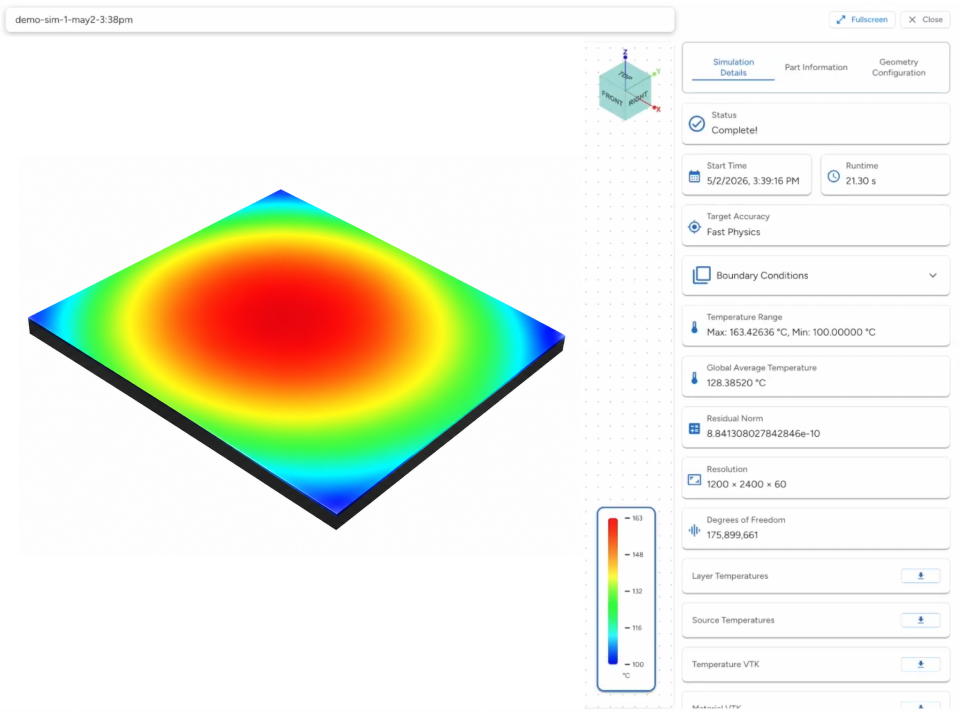
This session examines what becomes possible when solver-accurate thermo-mechanical analysis is available while the design is still moving. You will see thermoelastic warpage predictions run at manufacturing resolution directly from native design files, with no meshing and no manual setup, returning deterministic, FEA-level accurate results in minutes on a single node.
The most valuable physics insight is the one that arrives while there is still time to act.
High-fidelity warpage analysis has traditionally cost enough in setup, specialist time, and runtime that it gets scheduled once, late, on the version of the design a team can already defend.
Stackup, material set, die placement, and package architecture each constrain the next. Most are locked before anyone can say how the package will deform.
Satish Radhakrishnan runs a thermoelastic warpage prediction on an open-source package design: native geometry in, manufacturing resolution, no human meshing, deformation result back in minutes, and one design comparison to show what the result would change.
One leading semiconductor customer compared a 200-case design-of-experiments sweep in Vinci against their traditional thermal workflow. Vinci completed the sweep in about an hour with setup in under a minute; the legacy workflow took roughly 16 hours to run, not including setup.
When this class of analysis runs in minutes, the process can change. Thermo-mechanical risk becomes a constraint available throughout design rather than a validation step at the end.
Founder, SemiWiki
Daniel Nenni is the founder of SemiWiki, the open forum for semiconductor professionals, and a long-time industry observer covering EDA, IP, and foundry.

Chief Marketing Officer, Vinci
John Bruggeman is Chief Marketing Officer at Vinci, where he leads the company’s market narrative and positioning. His work focuses on translating complex technical advances into industry relevance and adoption, and on framing how physics enters the engineering workflow.

Head of GTM, Semiconductor & Electronics, Vinci
Satish Radhakrishnan leads go-to-market for semiconductor and electronics at Vinci, working across technical strategy, industry engagement, and adoption. His background in simulation, advanced packaging, and applied physical systems gives him a practical, engineering-led view of what it takes to run thermo-mechanical analysis inside production workflows.
Hello, my name is Daniel Nenni and I’m the founder of SemiWiki.com the open forum for semiconductor professionals. Since going online in 2011, SemiWiki has registered more than 375,000 members. If you’re not a member of the semi community, please register as my guest. Hope to see you there.
Today’s webinar is titled shift left on warpage thermo-mechanical analysis before the design locks. The speakers today are Satish Radhakrishnan and John Bruggeman. If you have questions, please submit questions in the chat box and we’ll respond during the Q&A or via email after the webinar. A link to the replay will be sent out after the webinar for you to share with your colleagues.
Okay, let’s get started. Over to you, John. >> Hello everyone. Thank you for joining today’s webinar.
I want to start this session with a pretty simple assertion. Warpage has a timing problem. And by this I mean engineers have been able to model warpage accurately for a very long time. We have sophisticated FAE tools.
We have incredibly talented CAE teams. We understand the underlying physics. So the problem isn’t we cannot predict warpage. The problem is when we can predict it.
Look at the engineering process here. We make decisions about architecture. We make decisions about material stackup, geometry, die placement, bonding, process conditions. And those decisions start very very early on.
But highfidelity thermo-mechanical analysis tends to enter the process much much later. Often as we get closer to verification and sign off and most frequently after build itself, we are making these decisions that ultimately determine warpage upfront yet we don’t have the highfidelity understanding of their physical qu consequences until much much later. That’s what I mean by the timing gap. And that’s really the thesis we’re going to explore today.
What if we could change that gap, actually close it? What if highfidelity warpage understanding could arrive while decisions that determine warpage are still being made? To understand why that matters, let’s look at where warpage actually comes from. Warpage isn’t created at verification.
It’s the accumulated physical consequences of decisions that have made been made throughout the design process. Look at a modern advanced package like this. There isn’t one decision that determines warpage. There are hundreds.
Package architecture, stackup, material selection, die placement, layer thickness, package and substrate dimensions, process and thermal conditions. And of course, these decisions aren’t independent. They all impact each other. Now look at what happens when these decisions are still being made.
Most of them happen while the design is still evolving. That’s what’s important because this is exactly when physics has the greatest potential leverage. When I still have choice, when changing a material is a design decision, not a redesign decision. when changing the stackup is an optimization not a late stage problem when I can still explore rather than simply validate.
So there’s an important idea I want you to keep in mind. Warpage is the physical consequence of decisions made throughout the design process. But that doesn’t necessarily mean we understand those physical consequences when we make those decisions. So we’d like to find out how this actually works in [snorts] your organization.
And rather than us make up and tell you the result, we put an online survey into social media 7 days ago and we’ve been collecting information from you, data from you, and we’d like to tell you what we learned. So the question we asked was when does highfidelity warpage analysis typically enter your engineering process? And I’m sure what we learned will not surprise you. We learned that the analysis was being done much much much later in the process than when those decisions were initially made.
That’s interesting, but probably not surprising at all to all of you. So a significant portion of the respondents to the survey admitted that they don’t have highfidelity warpage understanding until after build happens. So I think it’s important to be precise about why highfidelity warpage analysis arrives so late and so infrequently in the process. It isn’t because the traditional FAE or legacy technologies don’t work.
In fact, they work extraordinarily well. The problem is what it has historically taken to use those solutions to get a highfidelity answer. You have geometry preparation. You have meshing and often a lot of human expertise and art to be involved in getting that mesh just right.
You have workflows that depend on very highly specialized and practically scarce resource and specialized engineers to do it. And then you have the computational cost. And as designs become larger and larger, more and more complex, and as you try to preserve manufacturing resolution, that problem exacerbates. So an analysis might take hours, it might take days, and if you track my LinkedIn post, [clears throat] I give real examples that have taken weeks and even months.
But the bigger constraint isn’t any one of those pieces. It’s the combination of all of them. Time, expertise, preparation, and compute. And making sure they all come together in an optimized way.
And organizations deal with this in practically the same way. They ration it. They don’t run highfidelity thermo-mechanical analyses on every question they wish they could answer. They don’t explore every possible design alternative.
They pick a select few, a handful, and you run the physics and you wait for a checkpoint. So you use it for validation and verification. you don’t use it for intelligence to inform and help you make a better decision. And that’s how we ended up with the operating model that virtually every hardware engineering organization uses.
Physics is applied at selected checkpoints and not at the pace engineering decisions are being made. That’s why this timing gap exists. And that’s what leads to one of the most important ideas in this entire webinar session. An analysis used to take 10 hours.
Now it takes 10 minutes. We saved 9 hours and 50 minutes. But that’s not the important math. The important math is what weren’t you doing?
because physics took 10 hours. Maybe you evaluated five design alternatives when you really wanted to evaluate 500. Maybe you selected a stackup or a geometry with incomplete physical understanding. Maybe you added margin because you couldn’t explore the design space fully enough to know where the actual boundary was.
And maybe you discovered a problem later when the design was harder and more expensive to change. That’s the real economic consequences of rationing physics. It’s not simply slower productivity. It’s fewer alternatives explored.
Its decisions made with incomplete physical understanding. It’s additional engineering cycles. It’s ultimately program risk. So when we talk about the cost of slow physics, I think we have to change the unit of measure.
The biggest cost of slow physics isn’t the analysis. It’s the decisions you have to make without information. And that brings us to the second poll we launched this last week. Seven days ago, we put out a poll that asked what decisions you make before you ever understand the their warp pitch impact.
And we gave four categories of choices. We gave geometry, material selection, layer thickness, process thermal conditions. And it was fascinating. There was no heavy weight on any single thing.
People were making decisions across all four categories well in advance of physical information and intelligence being able to influence the decisions in those four categories. All right, let’s imagine if you will that same engineering process that we started this session with architecture, design, optimization, verification, and build. But we change one thing, just one thing. Instead of highfidelity physics appearing at a handful of selected checkpoints, imagine that physical understanding was continuously available underneath the entire engineering process end to end.
You make an architecture decision, you can understand its physical consequence. You change a material, you can understand what happens. You change the stackup, you can understand what happens. You change the geometry, you can understand what happens.
And then you change it again and the physics keeps up. So rather than asking is this question important enough to justify running highfidelity analysis engineers can start asking what does physics tell me about the decision I’m making right now. Physics is available when decisions are made. It updates as the design changes and that physical understanding persists throughout the engineering process.
This is called continuous physics reasoning. And for warpage, the implication is very simple. Warpage moves from something you update to something you design around. And this is where Vinci comes in.
And there’s an important distinction I want to make before Satic actually demonstrates the technology to you. Vinci isn’t simply taking the traditional simulation workflow and making it solve faster. We started with fundamentally different premise. What would you have to build if you wanted physical understanding to operate at the pace of engineering?
The result is an AI native computational platform that we call the Vinci intelligence platform. You give Vinci the engineering design data and the engineering intent natively and Vinci understands that native design the geometry materials interfaces and constraints. It reasons about the physics required to answer the engineering questions. It computes deterministic solver grade physical answers at manufacturing resolution at the pace of a speeding bullet and it carries that physical context forward as the designs and the questions change with knowledge.
Underneath that are several important technologies we’ve built. One, geometry intelligence and automated meshing, a foundation model for physics that zero shot out of the box can run the physics equations. GPU physics kernel to give the deterministic manufacturing resolution response and an agentic harness to manage over the workflow and there are few things in there that are worth a double click. We are operating on native native engineering designs no matter how big they are.
The preparation and meshing stages are automated and almost instantaneous and there’s no customer specific training or fine-tuning with their data required to tune the foundation model. It works zero shot out of the box and we’re producing manufacturing resolution physical understanding in seconds or minutes as Satish will show you and that’s what changes in the operating model because if you remove the preparation bottleneck you reduce the dependence on scarce specialists workflows and you change the computational economics by orders of magnitude. Physics doesn’t have to be rationed or wait to appear downstream. It can move upstream, move left where the decisions are being made.
I think the worst thing we can do at this moment is show you another PowerPoint slide or architecture slide. rather show you what makes this possible and I’ve asked Satish to join us to do that. >> All right. Hello everyone.
So I’m going to show three examples of how Vinci can enable manufacturing resolution uh simulation for warpage for thermo-mechanical analysis. The first example is we call a chip warpage example. This is basically a logic chip and increasingly for different designs you have to go with more layers, complex materials and increasingly lower and lower thickness and that increases the warp page. That’s the first example that I want to show you.
This is an example of a chip layer model of a of a die used in a memory or something which is over 40 micron thick silicon with 8 metal layers and the resolution used here is about 2.5 micron mesh size resolution because of the thickness you do see the warpage value to be a bit high but the key thing is this entire model being meshed at that resolution about 1.6 6 billion degrees of freedom and this entire thing was solved in about 157 seconds. That is about 2 and 1/2 minutes. That is a speed at which you can get a manufacturing resolution warp page analysis of a chip for a very complex design. And this could be done extremely fast as the design is evolving.
So the engineering decisions can be made as it’s being done. That’s the very first case and this is how at least the result of which you can enable decisions through the design process. The next use case we want to talk about is uh HBM which is very popular these days about a high bandwidth memory design. That design keeps on changing from HBM 3, 3E, 4, 4E, 5 etc.
and increasingly is going towards a custom design. A lot of fing decisions are being made. The base size keep changing. Thermal and mechanical concerns are paramount that they want to determine very beginning.
And the challenge is that any design that changes is going to affect your entire warp page. are you going to be able to bond this particular HBM chip to an AI GPU architecture uh chip etc. So you want to design it or and determine what the value is right when it’s designed. This is a second example I want to show where and it’s a eight layer.
So you can see there are eight different layers that is being of a chip that’s bonded on top of each other. And this simulation also very large about 1.8 billion degrees of freedom run in about 225 seconds. So a little longer but entire complex analysis shows how much of a warpage this is going to be. The larger the size that’s the industry is driving towards a larger HBM is going to be a big issue in terms of warpage and depending on what manufacturing process they’ll have determined whether this value satisfies the manufacturing constraint for the warpage limits.
So this is a full resolution for an entire HBM uh chip with multiple layers stacked up on top of each other. The third use case, let’s go to a completely different one. Let’s talk about uh an advanced PCB. PCB boards could be very large with lot of layers with complex structures.
And as you heat up the PCB to bond your die, that also works. You want to understand how much it warps, how much it warps in the area of concern that you have where you’re going to be bonding your chip. It’s a very different design, very different geometry and still you’re able to see that Vinci is able to predict that design for this particular kind of geometry. That’s the third example that I’m showing.
This is a PCB where you are trying to uh determine the W page and this one was also very large a 1.85 billion degrees of freedom. This ran in just over 2 minutes to determine the W page. You can see the W page very different from one location to another location. A localized W page change that you can predict with this platform.
And the AI is so generalized. It can go from a chip to a chip stack to a PCB or any of a design that you have to determine what page at your resolution that you want at the time of the phase of your design evolution. architecture design optimize verification build at any stage you can get your results extremely quickly. So what you just saw here are the accurate fast full fidelity native resolution and generalizable to the extent that any design that you get it could be simulated.
simulations are accurate has been verified with whatever resolution current EDA solutions available more importantly validated against experiments and as you could see they are extremely fast fidelity and it can scale to any design design uh changes that goes throughout the process or design decisions being made through the day it follows your design decisions as they are being made and it’s very general to the extent as long as the physics is the same any design that you take it’s going to predict that’s zero short generalization that vinci brings in here high fidelity wpage physics is no longer rationed you can get it done instantly for the design at whatever stage that you are so it’s easy to look at what satic just showed us and conclude that Vinci makes warpage simulation dramatically faster and that is true but that is not the important part. The important part is what happens when you remove time preparation and scale constraints. Think back to where we started. We make hundreds of decisions that ultimately determine warpage.
an historically highfidelity physical understanding arrived too late to impact any of those decisions. But what Satish just showed you changes that because when physics can operate at the speed of seconds and the scale of billions of degrees of freedom, you can explore hundreds or thousands of alternatives while the design is still fluid. You can understand the physical consequences of a meaningful design change before you ever have to commit to it. And you can optimize architectures, materials, stackups, geometries using highfidelity physics, not simply use physics to verify what happened based on the choices you made.
The breakthrough is this. Workbench is no longer has to be something you discover. It can be something you design around. Let that sit in for a minute.
And it represents a fundamentally different role for physics in engineering. Physics moves from validating the design to informing the design. That’s the shift from episodic simulation to continuous physics reasoning. So now I’d like to turn this back to you one last time, not as just another poll we’ve been running for the last seven days.
I ask you to think about your own engineering process. Where does warp pitch understanding arrive too late for your use today? Is it during architecture when you’re making choices that will shape everything that follows? Is it when you’re choosing materials or stackups?
Is it during design iteration where you’d love to understand the warpage consequences every time the design meaningfully changes? Is it design space exploration where you might evaluate five or 10 alternatives but you’d like to evaluate thousands? Or is it correlation and debug where you’re discovering something physically that you wish you understood before you built it? If you could move highfidelity warpage understanding to the left, just one consequential workflow, where would you start?
Keep that workflow in your head because that’s exactly where we suggest starting, not with another demo. Bring us one consequential design decision. Not a benchmark, not a CAM demo. And you don’t need to start by figuring out how to deploy Vinci across your organization.
Start with one decision where you wish physics could inform the answer earlier. Tell us what are you trying to decide? When do you have to decide it? What thermal mechanical understanding would ideally inform that decision?
And most importantly, what would you do differently if you could? and Vinci will bring together a small SWAT team, a working group, typically three to five people involved in the engineering workflow and we will work through it with you. We’ll map the decision. We’ll map where physics enters today.
We’ll understand the constraint and we’ll determine where bringing highfidelity physics understanding earlier could materially change the decisions that gets made. Sign up here using the URL to create one of those working schedule one of those working sessions and we’re ready to go. And I’ll leave you with one last thought. Don’t start with Vinci.
Start with an engineering decision you wish physics could inform. Thank you. Satish and I thank you for your time and attention. Thanks.
>> Great presentation guys. Uh we do have some questions. So let’s get started. First question.
Engineers have been managing warpage for years. What has changed in hardware development that makes the traditional approach harder to sustain? So Daniel, I want to start by saying engineers didn’t suddenly forget how do we manage warpage. The issue is that design has continued to get more complex.
This pace at which development is going is rapidly outpacing anything we’ve ever had to deal with in the past. So traditional FEA, it’s extraordinarily good at solving physics, but getting the highfidelity answers that have always historically been required are just harder to get in the time that we we have available. We need to prep the model. We need to mesh.
We need to get specialists expertise involved. We need to call out compute. And it just all takes time. So we need an approach where we can have physics available at the point in which decisions are made so that we don’t end up having to ration physics in order to solve our problems.
>> Okay. Another question. When architecture, materials, and die placement are decided before highfidelity physics is available, how does that affect the rest of the program? >> Well, Daniel, I’ll tell you, it creates a whole cascading of consequences.
So, even though physics isn’t available the moment decisions need to be made, engineers still have to make those decisions. So they compensate for the uncertainty with the best choice they can make. But when you do that, you can leave performance on the table. You can overdesign.
You can build extra cost into your materials or complexity or just go with what you think is best and find out downstream that you’ve got a problem. when really is too expensive, too hard to make a change. >> Okay. In the presentation, you describe Vinci as an intelligence layer for hardware engineering.
What does that mean in practice and where does continuous physics reasoning fit? >> So, the very first thing I I want to be really clear, Vinci is not building a better simulation tool. We’re not trying to be faster, better, cheaper than what’s available in the marketplace. The solutions out there are fantastic.
What we are building, as you called out, is an intelligence infrastructure for hardware engineers. What that means is that physics intelligence is always available to any engineer at the moment they need that physics intelligence to make a better decision. So an engineer can start based on the actual engineering intent, the native design, the materials constraints and the question they’re trying to answer. Then the Vinci intelligence platform understands their problem.
We automatically prepare it. We reason about it and then we compute using deterministic physics at manufacturing resolution and that makes physical understanding available when the engineer needs to make a decision. Got it. So there’s a lot of attention on AI for engineering.
I mean it’s everywhere. What should teams require before trusting it to inform consequential design decisions? You know that’s a big question. Yeah.
The ve the very first thing and you’ve called it out. If we can’t trust the physics provided by AI, we’re just not going to use it. We’re not going to adopt it. So the very first thing I think is critical is that we need to compare it against the trusted solutions that we have today and see that the answers that legacy solutions provide we get that same answer using an AI based solution.
However, that’s just the start. So if you’re going to put AI in the path of a missionritical engineering decision, you can’t lower your standards or lower your expectations just because it’s AI. In fact, probably should raise your expectations because these decisions are on the missionritical path. >> Got it.
So you focused today on warpage but you know as designs become more interconnected across chips, packages and boards. What does that mean for you know the way teams understand physical behavior? So this is a great question. I really appreciate you asking it because we didn’t have the time to get anywhere near that question in today’s webinar.
So the very first thing we focused on warpage but warpage is just one of the the physical phenomena which affects our ultimate design and we can’t make a decision about warpage in abstentia of all the other important physical phenomena. So this whole specialization based on physics has got to change and we got to be able to use the same intelligence to be able to answer thermal conduction problems, transient conduction problems, warpage and thermal mechanical problems, electromagnetic problems all across the board. Because in the real world all these different physical influences affect the behavior of the chip. The Vinci approach is that one single foundation model is able to understand all of the physical phenomena and carry every decision in context of the greater physical problem we’re trying to solve.
Yeah, you you got that right. So the last question and this kind of sums it up. For an engineering leader evaluating this approach, what would be a meaningful first application and what would demonstrate that it’s changing how decisions get made? >> Well, I’m going to provide you with a counterintuitive answer to that question, Daniel, because intuitively you would say, give me a question I could benchmark against.
give me something in which I can already solve today and benchmark this Vinci against what I already know and yes you need to trust and you need to understand but that’s such a easy starting point I think the more exciting the more interesting place is to use Vinci to explore something that isn’t practical Today, instead of evaluating five alternatives, evaluate 500 or 5,000 running massive DOE. Analyze the complete and entire design space at manufacturing resolution instead of simplifying it. more. Put highfidelity physics directly into an iterative design process so engineers can understand the physical consequences of decisions while the decisions are still being made.
Our most successful customer engagements are those not where they’re benchmarking us against problems they already know how to solve, but it’s those innovative, it’s those forwardthinking customers that are saying, “How do I explore the art of the impossible?” Great answer, John. Thank you for your time and thank you everyone for participating in the SEAWiki webinar series and have a good day.
If this session made you think of decisions your team currently makes before thermo-mechanical analysis is available, the next step is not another generic demo. Bring the people who actually make and support those decisions into the room. Put together five relevant people from your organization and we will work through how this applies to your actual engineering process, on your design constraints, not ours.
Set up a working session