
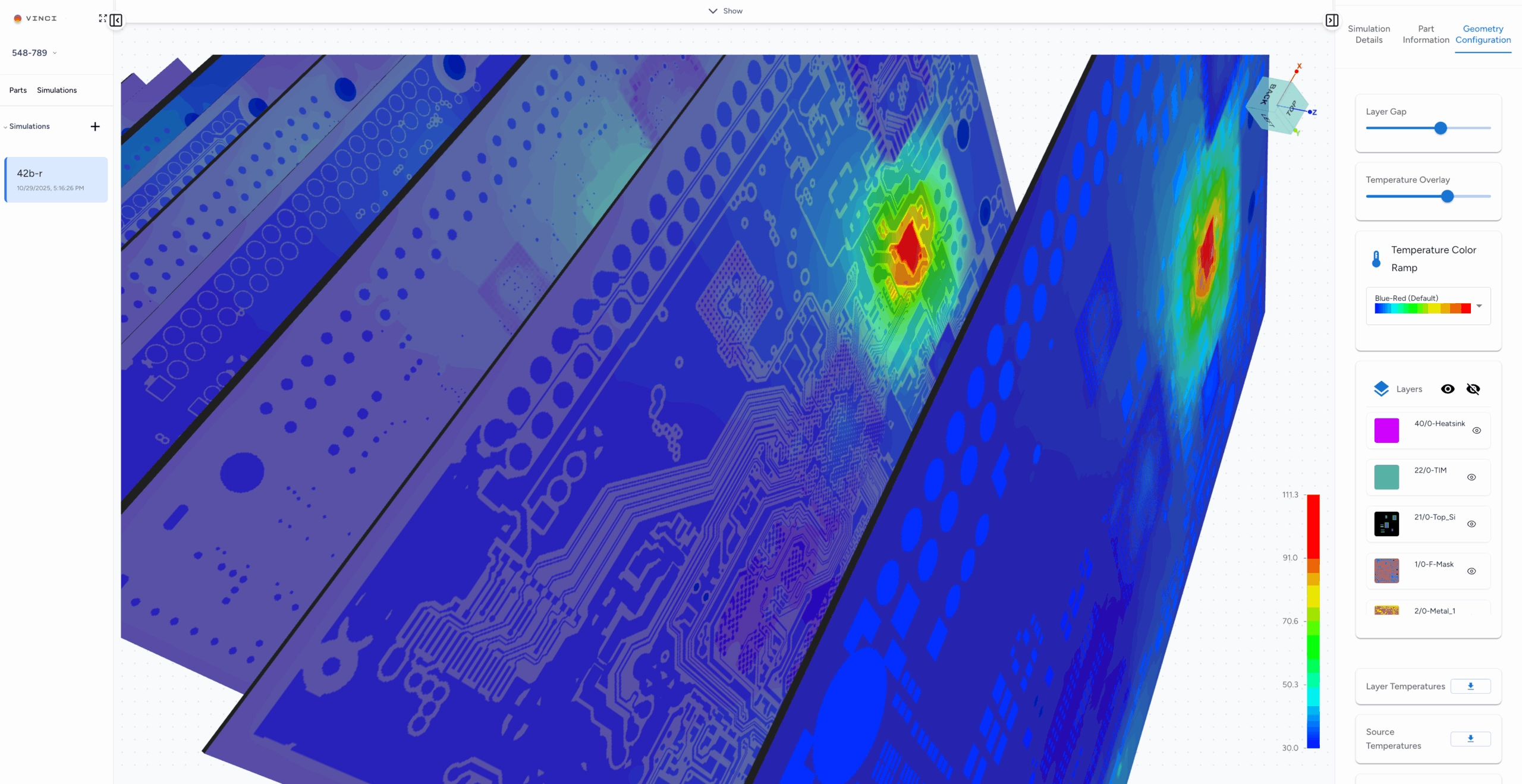
In hardware development, speed creates market opportunity, competitive advantage, and the ability to innovate. Traditional simulation tools have always been a time sink (especially when they involve a heat sink). Even for experts, running a high-fidelity thermal or structural analysis can take hours or days. Vinci changes that.

THE OLD WAY: SLOW, SPECIALIST-ONLY SIMULATION
In most organizations, the simulation process is sequential and centralized. A design engineer submits a request to a simulation specialist, who preprocesses the CAD files, creates a mesh, sets boundary conditions, and runs the solver. The turnaround time can stretch to days, especially if revisions are needed. This slows iteration and forces engineers to make decisions without timely validation, and can result in shipping products that are not optimized for their task.
THE NEW WAY: FAST AI-NATIVE PHYSICS
Vinci’s model collapses this process into seconds. Engineers can load a design file, specify the conditions of interest, and receive validated results almost immediately. There is no meshing step, and no need for a dedicated analyst. The AI model predicts the system’s physical behavior directly from the raw geometry, boundary conditions, and physical parameters, all guided by the laws of physics it was trained on.
IMPACT ON THE DEVELOPMENT CYCLE
Faster simulation changes the economics of design. Engineers can run more iterations per day, explore more design alternatives, and validate decisions earlier in the process. This reduces late-stage rework and enables aggressive timelines. In competitive sectors like semiconductor, automotive, and electronics, this speed translates directly into first-to-market advantage.
A CULTURAL SHIFT IN ENGINEERING
When simulation is instant, it becomes part of everyday engineering practice. Designers can test assumptions in real time, troubleshoot issues as they emerge, and collaborate more freely with colleagues across disciplines. Over time, this shift leads to higher design quality and a stronger engineering culture.