

In most engineering organizations, high-fidelity simulation is a scarce resource. It is handled by a small number of experts who manage specialized software, set up models, and interpret results. This centralization ensures accuracy, but it also creates bottlenecks that slow product development.
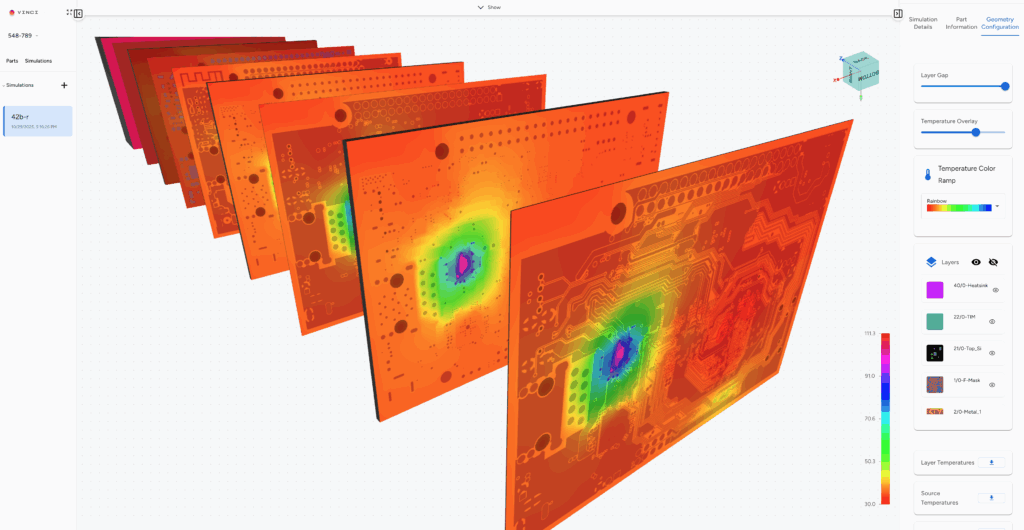
Vinci changes that dynamic. It removes the need for deep simulation expertise to run a validated, high-resolution analysis. Any engineer with a CAD model can run the equivalent of a specialist-grade simulation in seconds, without meshing or solver setup.
BOTTLENECK BY DESIGN
Traditional tools like Ansys or COMSOL are optimized for expert use. They require careful pre-processing, including geometry cleanup, mesh generation, and boundary condition setup, as well as skilled interpretation of the output. This complexity is part of why simulation groups exist. It also means that design engineers often make critical decisions without timely access to simulation feedback.
DIRECT-TO-ENGINEER SIMULATION
With Vinci, the workflow is stripped down. You open your design file, set operating conditions, and receive a full-resolution simulation output almost immediately. There is no intermediate mesh step, and no manual solver control. This changes the cadence of design. Engineers can now run “what if” scenarios during the actual design session instead of parking them for later review.
QUALITY CONTROL IN A DISTRIBUTED MODEL
Removing the simulation bottleneck does not mean lowering quality standards. Vinci’s outputs are constrained by physical laws, validated with traditional methods, and continue to improve. This allows teams to keep expert oversight where it is most valuable, usually on complex edge cases or final verification, while freeing everyday design work from delays.
CULTURAL EFFECT
When simulation is available to everyone, design conversations change. Engineers can bring quantified data into early-stage discussions instead of relying solely on intuition or prior experience. This leads to better-informed decisions, faster resolution of design trade-offs, and a stronger feedback loop between design and validation.
For engineers, having a simulation copilot means not waiting for permission to check an idea. For teams, it means the collective design intelligence expands beyond the boundaries of the simulation group. In the long term, this may be the most significant change Vinci enables, making simulation a core skill across the entire engineering organization.
