
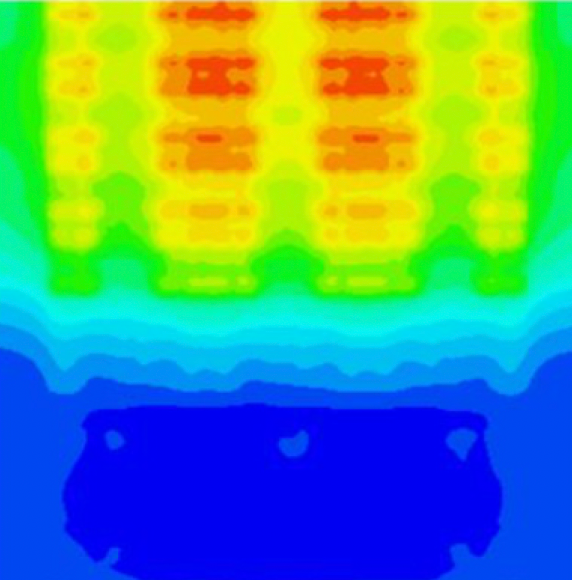
For decades, hardware design has been constrained by the limits of traditional simulation tools. While software engineers have leveraged Large Language Models (LLMs) to accelerate development cycles, hardware engineers still rely on slow, specialist-only workflows. Vinci’s foundation model for physics corrects that imbalance.
Vinci is the first AI-native foundation model trained on physics, not customer data. Today, it understands thermal conduction, convection, and warpage. In the near future, it will expand to understand all physics-based properties, such as structural stress, material deformation, and fluid dynamics, all at the most fundamental level.
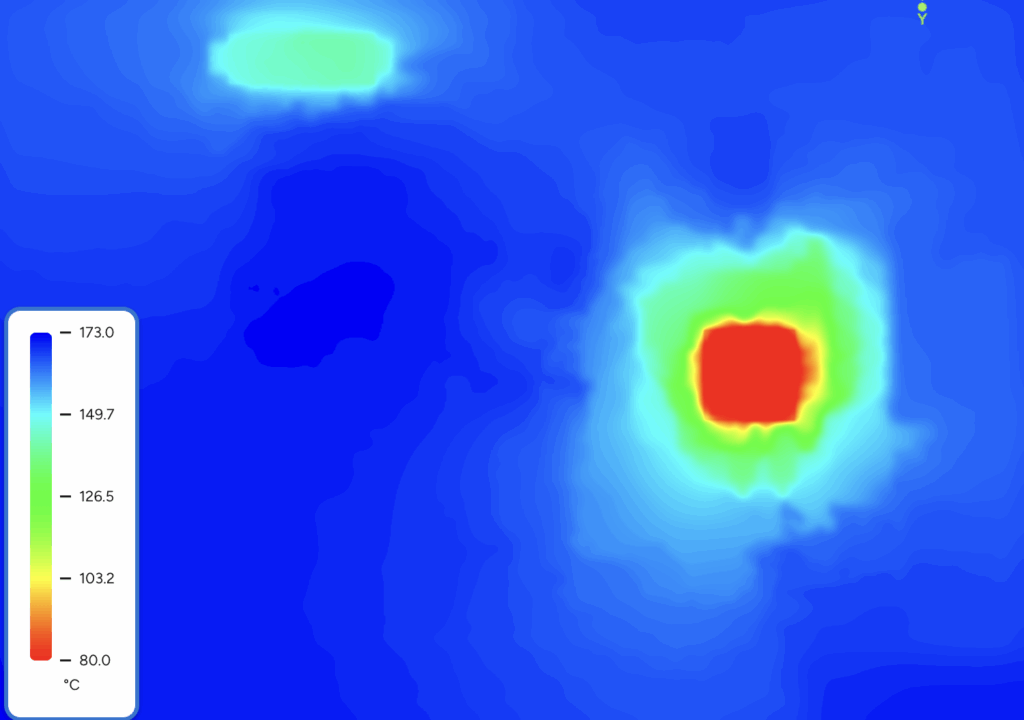
THE PHYSICS-FIRST APPROACH
Unlike black-box AI systems that generate output by statistical association, Vinci is grounded in verifiable physical principles. Every prediction it makes is checked against the same equations and models that underlie conventional simulation software. This eliminates the risk of hallucinations, so results are both fast and dependable.
BREAKING THE SPEED BARRIER
Legacy simulation pipelines are bottlenecked by computational overhead. Meshing, solver convergence, and domain-specific preprocessing all take time. Vinci bypasses these steps by working directly on full-resolution design files, and predicting physical behavior in minutes. In real-world benchmarks, Vinci runs up to 1000× faster than traditional finite element analysis (FEA) tools.
UBIQUITOUS SIMULATION
Today, simulation expertise is concentrated in the hands of a few specialists. This creates bottlenecks and delays, especially in large organizations. With Vinci, any engineer can initiate a high-fidelity simulation without deep domain training. This enables parallel iteration across teams and earlier validation in the design cycle.
SCALING ENGINEERING CAPABILITY
The power of Vinci is its scalability. Once deployed, it can be integrated into every stage of the hardware lifecycle, from early prototypes to manufacturing optimization. As more teams adopt it, the organization benefits from faster cycles, fewer design flaws, and a broader set of contributors capable of running critical analyses.
Vinci is more than a simulation tool. It is a shift in how hardware will be designed, validated, and optimized. By applying AI-native methods to physics, Vinci is bringing the same kind of leverage to hardware that LLMs brought to software.
