
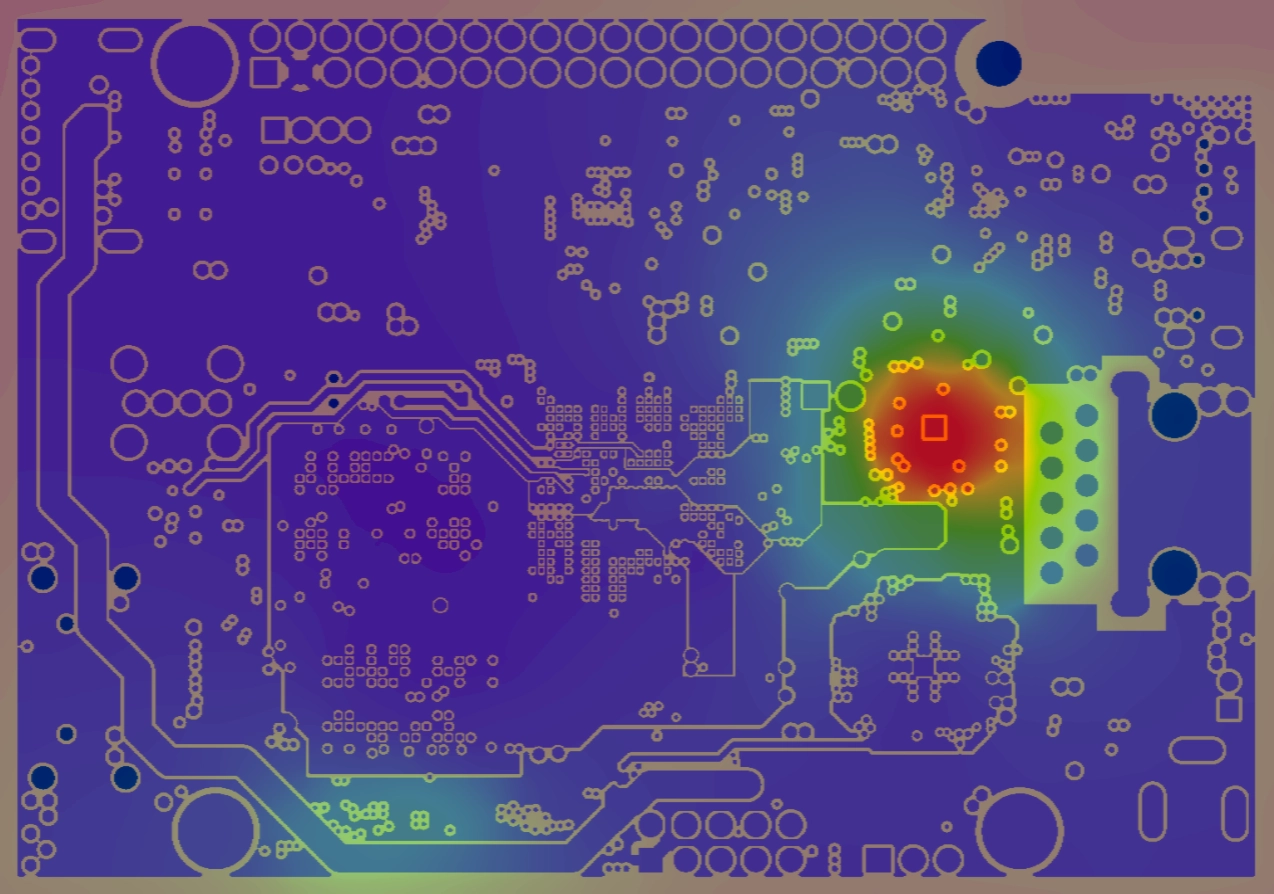
In engineering, an answer you cannot trust is the same as having no answer at all. Many AI systems require access to customer data for training, only to then generate results that are prone to hallucination. Both of these factors are non-starters for hardware design, where every calculation can have downstream manufacturing and safety implications, and where IP security is non-negotiable.
Vinci’s foundation model takes a fundamentally different approach. It is trained on the underlying laws of physics, not customer-provided designs. This distinction matters, so it’s worth repeating: Vinci does not require customer data for training its model. Instead, the model’s predictions are anchored in verifiable equations. These are the same thermodynamic, structural, and material behavior laws engineers already use, applied in a large-scale model.
WHY GROUNDING MATTERS
General-purpose AI models work by identifying statistical patterns in their training data. They may generate plausible outputs, but plausibility is not proof. In a design context, this can manifest as geometry that “looks” correct but fails under load, or a thermal profile that appears reasonable but violates heat transfer constraints.
An AI trained directly on physics has a smaller search space. Every predicted result is constrained by governing equations. This makes it possible to verify outputs without guesswork, and to use the AI as a direct extension of established engineering workflows.
VERIFICATION AND TRACEABILITY
Vinci’s predictions are derived from physics-based modeling, so results can be automatically cross-checked with the same physics & mathematics that power the model, discarding anything that’s incorrect before it is proposed as a result.
NO IP LEAKAGE
Vinci’s model is never trained on customer files. Design data stays in the customer environment and is never used for training. This prevents leakage of proprietary geometry or material data into the model’s weights. For industries with strict confidentiality requirements, such as aerospace, defense, and semiconductor manufacturing, this is non-negotiable.
FUNCTIONAL IMPLICATIONS
For engineering teams, Vinci allows faster iteration without sacrificing confidence. You can run a quick simulation mid-design, verify the result as needed, and continue development without risking an unverified answer or putting sensitive information at risk. Over time, this will shift simulation from an occasional checkpoint to a continuous design companion.
An AI model that cannot be trusted is not useful in engineering. By grounding its foundation in physics, Vinci is designed to be fast, reliable, and secure: all qualities that cannot be traded against each other in real-world hardware development.